 Polkadot
Polkadot nomination pools: DOT staking and reward claims
Polkadot nomination pools combine members' DOT into a shared stake that nominates validators and can earn staking rewards. Members control their accounts, while the pool's nominator selects validators. Rewards accrue to each member's share of the active stake, subject to the pool's earnings and commission. You can claim rewards to your account or bond them again; withdrawing the original stake follows an unbonding process.
A recorded membership confirms that you've joined, while claimable rewards require staking payouts. Polkadot runs these staking operations on Asset Hub. Pool administration, reward permissions, and withdrawal records determine how your participation continues after the initial bond.
The short version: Permissionless compounding lets other accounts reinvest your pool rewards, with each increase in bonded stake requiring an executed transaction.
Join a pool and confirm the bonded balance
Before a join request can succeed, your chosen pool must accept members and your DOT contribution must meet the network's minimum joining bond. This entry requirement differs from the combined stake needed for active nomination. Read the joining minimum in the staking interface; governance can change it.
Your account also needs enough available funds for fees and the required account deposit. A wallet's total balance can include funds already committed elsewhere. Review the amount that the interface allows for pool bonding, together with the pool's recorded settings.
- The pool is Open and has room under any configured membership limit.
- Your contribution meets the network's joining minimum.
- The nominated validators and recent payouts suit your staking choice.
- The pool commission and any change limits are acceptable.
- Your account has no existing pool membership and can cover the bond, fees, and required deposit.
With those conditions satisfied, a pool-capable interface prepares a join transaction for the selected pool and amount. Review that operation before signing. Submission sends the request to the network; a transaction identifier alone doesn't establish that the join succeeded.
After successful execution and finality, the member record should identify the selected pool and your active shares. The corresponding bonded amount confirms participation. Claimable rewards may remain empty at this stage because accrual depends on subsequent payouts to the pool.
If the pool changes to Blocked before execution, the request can fail. Read the finalized transaction result and the updated member record before another submission. If no join succeeded, refresh the pool's eligibility and your available balance before choosing an Open pool.
Pool shares and delegated DOT
Pool points measure a member's share of the pooled stake; the protocol converts those points into a DOT balance using the pool's accounting. They aren't an extra reward allocation. Delegation-based staking holds bonded funds in the member's account while the pool uses that stake to nominate validators. Those held funds aren't freely transferable. Members can also participate in Polkadot OpenGov with their delegated stake, although governance commitments follow separate rules and can continue to restrict transfers after the staking hold ends.
Who selects a pool's validators?
Validator selection belongs to the pool's nominator, with the pool's root role also authorized to nominate; individual members share that selection through their pooled stake. The operator can change nominations without requiring every member to unbond. Joining therefore delegates ongoing validator selection, including later changes to the nominated set.
Administrative roles have different powers. The root can replace the nominator or bouncer, while the bouncer can block joins and remove members under blocked-pool rules. Some roles can be unset. Review the assigned accounts alongside the nominations, especially if continued management depends on a single account.
A nomination pool enters the staking election as a single nominator. Its aggregate stake and nominations determine whether it backs elected validators. Membership alone doesn't establish reward eligibility for an era, the staking system's reward period. An inactive pool can leave every member without new staking rewards even when each member meets the joining minimum.
Polkadot's enacted 2026 staking reform removed nominator slashing for offences under the new rules. This includes pooled nomination stake, while validators' own stake remains slashable. Historical offences retain their era's rules. Validator performance still affects rewards, so the change doesn't create a fixed return.
How do pool rewards reach a member?
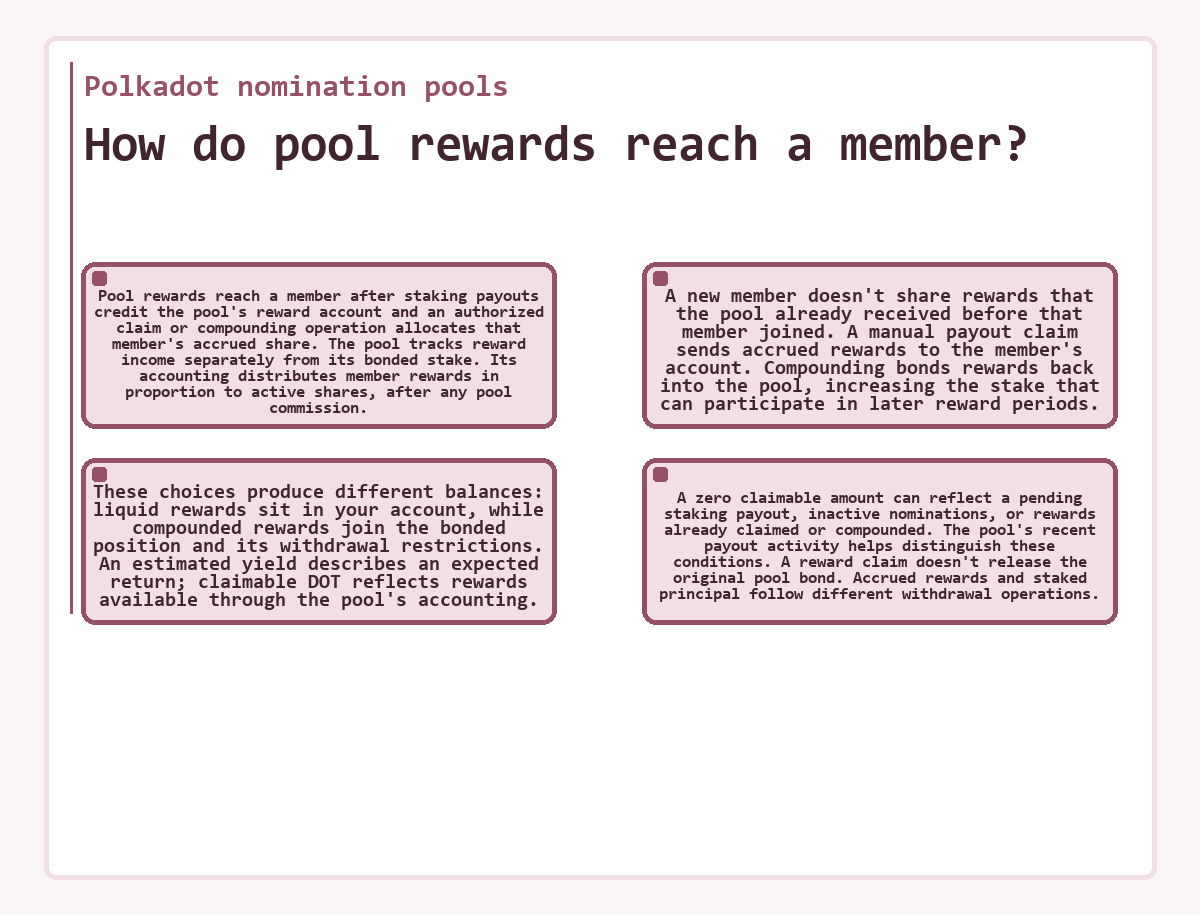
Pool rewards reach a member after staking payouts credit the pool's reward account and an authorized claim or compounding operation allocates that member's accrued share. The pool tracks reward income separately from its bonded stake. Its accounting distributes member rewards in proportion to active shares, after any pool commission. A new member doesn't share rewards that the pool already received before that member joined.
A manual payout claim sends accrued rewards to the member's account. Compounding bonds rewards back into the pool, increasing the stake that can participate in later reward periods. These choices produce different balances: liquid rewards sit in your account, while compounded rewards join the bonded position and its withdrawal restrictions.
An estimated yield describes an expected return; claimable DOT reflects rewards available through the pool's accounting. A zero claimable amount can reflect a pending staking payout, inactive nominations, or rewards already claimed or compounded. The pool's recent payout activity helps distinguish these conditions.
A reward claim doesn't release the original pool bond. Accrued rewards and staked principal follow different withdrawal operations.
Claim permissions and compounding
Claim permissions determine who can act on accrued member rewards and which action they can perform. With Permissioned, the member claims their own rewards. PermissionlessCompound allows anyone to compound them. PermissionlessWithdraw allows anyone to claim them to the member's account. PermissionlessAll permits both actions. Permissioned claiming is the default, so joining alone doesn't enable outside reward management.
These permissions concern reward execution, with the member remaining the recipient of a payout or the owner of compounded stake. They don't give the caller your signing keys or redirect rewards to that caller's account. A wallet or pool service may submit permitted calls, but the permission itself supplies no transaction schedule.
Compounding requires someone to execute the authorized operation. An enabled setting can remain unused if no account submits a successful call.
What can the pool charge?
A pool can deduct a commission from staking rewards before allocating the remaining rewards to members. The root sets the rate within the network's limit. Optional settings cap the pool's rate and constrain the size and frequency of increases. Once set, the pool-specific cap can only decrease, and change limits can only become stricter. The 2026 reform removed validators' rate-based cut of nominator rewards; pool commission remains a separate setting. Network transaction fees also apply to pool operations, independently of the commission that the pool charges.
Unbonding and changing pools
Unbonding moves the affected stake from active pool accounting into an unlocking state. That portion stops earning pool rewards. Partial unbonding preserves the remaining active position, provided it meets the applicable minimum. A full exit also requires withdrawal of matured funds. The 2026 reform shortened eligible nominator unbonding, while requests created before the change retained their original release schedules. The recorded unlock era determines a particular request's maturity; a newer network setting doesn't automatically rewrite that record.
An account can belong to only one nomination pool at a time. Switching therefore requires full unbonding and withdrawal from the existing pool before another membership can begin. This differs from changing validators within a pool: the authorized nominator can update that shared selection without each member leaving. Direct nomination gives an account control over its own validator choices, with different bond requirements and reward handling.
Member records can contain active shares and amounts unlocking in different eras. A displayed total contribution may include both, so it doesn't establish that the entire amount is withdrawable. Releasing the pool hold also leaves any separate governance restrictions in place. For matured pool funds, the relevant operation is withdraw_unbonded.
What readers ask about Polkadot nomination pools
Can I add more DOT without leaving my nomination pool?
An actively bonded member can add DOT to the same pool through the bond-extra operation. Additional stake can come from an eligible account balance or accrued pool rewards. The operation increases the existing position, so it doesn't create another membership or let the account divide its pool stake between different pools.
Does Polkadot allow direct staking and pool membership in the same account?
Polkadot supports simultaneous direct staking and nomination pool membership in the same account. The two positions use separate stake allocations and retain their own nomination and reward arrangements. Joining a pool doesn't automatically cancel direct staking, and it doesn't allow the same DOT allocation to earn rewards twice.
Why did rewards reach my account when I partially unbonded pool stake?
Pool unbonding automatically settles the member's accrued rewards before changing their active share. That payout can therefore appear alongside an unbonding request even without a separate manual reward claim. The rewarded DOT and the unbonding principal have different states: the reward payout doesn't mean that the principal has finished its waiting period.
Is it possible to cancel a nomination pool unbond and rebond that stake?
Nomination pools don't support rebonding stake that's already unbonding. The affected funds must finish their recorded waiting period and become withdrawable before they can return to a pool bond. This restriction applies to the unbonding portion; any stake that remains actively bonded continues as a separate part of the position.
What happens to my DOT if the nomination pool starts closing?
A pool in the Destroying state allows anyone to initiate members' unbonding and eventual withdrawal under the protocol's rules. Closing doesn't make the stake instantly spendable or transfer it to the administrator. The pool can't return to Open once destruction starts, and its depositor can leave only after the other members have left.
Do accrued pool rewards expire if I leave them unclaimed?
Rewards that the pool has already accrued for a member don't expire under pool reward accounting. Upstream staking payouts have a runtime-defined claiming window, which is a separate requirement before funds reach the pool's reward account. Leaving member rewards unclaimed also doesn't automatically compound them into the active stake.
Can a proxy manage my nomination pool without receiving my account keys?
A nomination-pool proxy can sign supported pool operations within the authorization that you grant. The proxy uses its own account keys, so sharing your recovery phrase isn't part of that arrangement. The restricted proxy type doesn't authorize arbitrary balance transfers; broader proxy types carry different permissions that need separate consideration.